Do we know what we're talking about?
What exactly do we mean when we talk about “pedophilia”? I’m not referring here to the scientific definition or specific age limits regarding one’s preferences. Rather, I’m referring to the linguistic ambiguity: When you talk to someone else, do you assume that they understand each of your words in the same way you do?
One could take the word “friendship” as an example, a term with which almost everyone has certainly experienced some ambiguity: For some, friendship is a loose construct without obligations, one that is quickly formed and lasts for a while. For others, strong trust and commitment are essential components. Some seek common ground, while others say, “Opposites attract.” And what distinguishes a schoolyard friendship from an adult friendship?
Perhaps it’s a mistake to use the same word for all these concepts. As a result, everyone puts different things into the “friendship” category, and sometimes that leads to conflict. As long as we don’t eventually master telepathy, we’ll have to live with the quirks of language. And in doing so, it’s helpful to know where the problems lie, and to that end, I made an observation some time ago and investigated the question via a survey tackling the question: What is “pedophilia”?
Method
In the forums Gemeinsam statt allein (GSA), Virtuous Pedophiles (VirPed), and Girlloverforum (GLF), I created a survey thread each asking the question: What would you call “pedophilia”? (German: “Was würdest du „pädophil“ nennen?”) There were 14 possible answers to this multiple choice question, with which I attempted to cover the essential nuances of meaning that I have observed in the community. Starting at the beginning of the year, I took screenshots to analyze the results (most recently on February 22, 2026).
The English items were kept as close as possible to their German equivalents (see Table 1). I hope I’ve done a good job with the translation.
| No. | Reply options in German | Reply options in English |
|---|---|---|
| 1. | Nur wenn der GRÖẞTE Teil der sex. Präferenz auf Kinder gerichtet ist | Only if BIGGEST part of sex. preference is to kids |
| 2. | Nur wenn der GRÖẞTE Teil der sex. Präferenz auf Minderjährige (<18) gerichtet ist | Only if BIGGEST part of sex. preference is to minors |
| 3. | Wenn ein GROẞER TEIL der sex. Präferenz auf Kinder oder Minderjährige gerichtet ist | If A BIG PART of sex. preference is to kids or minors |
| 4. | Auch bei 50/50 zwischen Erwachsenen und Kindern/Minderjährigen | What about half and half between adults and kids/minors? |
| 5. | Wenn man sich auch nur etwas zu Kindern/Minderjährigen sex. hingezogen fühlen | If you experience any sex. attraction to kids/minors AT ALL |
| 6. | Sexuelle Anziehung zu Kindern/Minderjährigen ohne emotional-romantischen Anteil | Sexual but not emotional/romantic attraction to kids/minors |
| 7. | Romantische Anziehung zu Kindern/Minderjährigen ohne erotisch-sexuellen Anteil | Romantic but not erotic/sexual attraction to kids/minors |
| 8. | Eine Phase, in der man sich zu Kindern/Minderjährigen hingezogen fühlt, die später womöglich abklingen kann | A phase where you feel attracted to kids/minors that may subside later |
| 9. | Wenn man Kinder nur deshalb sexy findet, weil sie in gewissem Maße Erwachsenen ähneln | If you find kids only sexy because they resemble the adult form to some degree |
| 10. | Man ist nicht wirklich pädophil, wenn man sich NUR SEX mit Kindern wünscht und sie nicht auch LIEBT. Das wäre dann eher ein Fetisch oder „pädosexuell“ | You’re not really pedophilic if you would just like to have sex with kids and don’t also LIKE them. That would be some fetish or „pedosexual“ instead. |
| 11. | Ich bevorzuge „MAP“, da „pädophil“ in der Gesellschaft oder in meiner Vorstellung viel zu sehr mit Missbrauch verbunden ist | I prefer „MAP“ since „pedophilia“ is connected way to deeply to abuse in society or in my mind |
| 12. | Ich mag „pädophil“ nicht verwenden, sondern aus einem anderen Grund eher „MAP“ | I wouldn’t use „pedophile“ but rather „MAP“ for some other reason |
| 13. | Ich mag „pädophil“ nicht verwenden, sondern einen anderen Begriff | I wouldn’t use „pedophilia“ at all but rather some other term |
| 14. | Etwas anderes | Something else |
Results
The N value in the following tables reflects the number of votes cast per forum. This is not the same as the number of participants, but it is the only total figure I have. Unfortunately, the forum software does not count the number of user accounts that voted but rather the number of votes cast, since multiple selections were allowed. This means that the total number of votes for an item (see Table 2) actually reflects the number of user accounts that voted in favor; the percentages (see Table 3), on the other hand, represent the percentage of the total number of votes. To ensure comparability between the forums, I use the percentages for the evaluation.
Table 2: Raw data, number of votes
| GSA | VirPed | GLF | ||
|---|---|---|---|---|
| 1. | BIGGEST part: children | 4 | 6 | 13 |
| 2. | BIGGEST part: minors | 2 | 4 | 1 |
| 3. | A BIG PART of sex. preference is to kids or minors | 3 | 7 | 2 |
| 4. | half and half between adults and kids/minors | 9 | 5 | 4 |
| 5. | even minimal sex. attraction to kids/minors AT ALL | 3 | 19 | 3 |
| 6. | sex. attraction without emotional-romantic aspect | 7 | 7 | 4 |
| 7. | romantic attraction without erotic-sexual aspect | 3 | 5 | 7 |
| 8. | a phase that will fade over time | 0 | 1 | 2 |
| 9. | kids = sexy, because similar to adults | 1 | 1 | 0 |
| 10. | wishing for sex alone but not for love = not pedophilic | 0 | 2 | 5 |
| 11. | I prefer “MAP”, because “pedophile” is connected to abuse | 3 | 4 | 1 |
| 12. | I don't like “pedophile” (use “MAP” instead) | 0 | 1 | 0 |
| 13. | I don't like “pedophile” (use some other term instead) | 1 | 1 | 0 |
| 14. | Something else | 1 | 1 | 2 |
| Sum N | 37 | 64 | 44 |
Table 3: Percentages of the total number of votes N
| GSA (N=37) | VirPed (N=64) | GLF (N=44) | ||
|---|---|---|---|---|
| 1. | BIGGEST part: children | 10.8% | 9.4% | 29.5% |
| 2. | BIGGEST part: minors | 5.4% | 6.3% | 2.3% |
| 3. | A BIG PART of sex. preference is to kids or minors | 8.1% | 10.9% | 4.5% |
| 4. | half and half between adults and kids/minors | 24.3% | 7.8% | 9.1% |
| 5. | even minimal sex. attraction to kids/minors AT ALL | 8.1% | 29.7% | 6.8% |
| 6. | sex. attraction without emotional-romantic aspect | 18.9% | 10.9% | 9.1% |
| 7. | romantic attraction without erotic-sexual aspect | 8.1% | 7.8% | 15.9% |
| 8. | a phase that will fade over time | 0% | 1.6% | 4.5% |
| 9. | kids = sexy, because similar to adults | 2.7% | 1.6% | 0% |
| 10. | wishing for sex alone but not for love = not pedophilic | 0% | 3.1% | 11.4% |
| 11. | I prefer “MAP”, because “pedophile” is connected to abuse | 8.1% | 6.3% | 2.3% |
| 12. | I don't like “pedophile” (use “MAP” instead) | 0% | 1.6% | 0% |
| 13. | I don't like “pedophile” (use some other term instead) | 2.7% | 1.6% | 0% |
| 14. | Something else | 2.7% | 1.6% | 4.5% |
Percentages in a diagram:
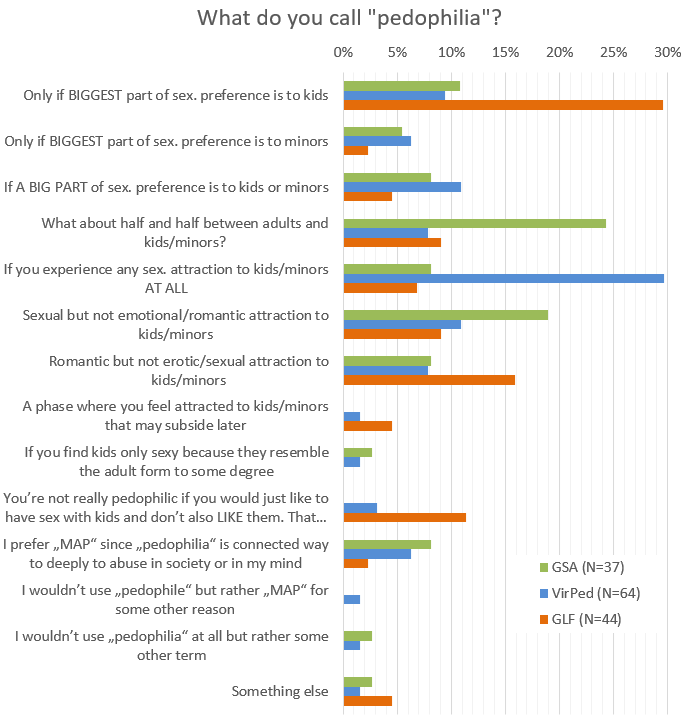
As can be seen, in every forum exactly one option receives by far the largest share of votes: specifically, one of the response options that defines a lower threshold for what can already be called “pedophilia.” According to GSA, therefore, for pedophilia to be present, there must be at least an equally strong pedophilic preference as there is for teleiophilic preference. At GLF, pedophilia must be the dominant preference. For voters at VirPed, on the other hand, even a slight sexual response to children is sufficient to classify someone as a pedophile.
When asked about erotic versus romantic attraction alone, the responses show that GSA and VirPed give preference to purely sexual attraction, while at GLF, emotional attraction alone is more suitable for defining pedophilia (15.9%) than the sexual component on its own (9.1%).
A “pedophilic phase” is not considered to be true pedophilia in any of the three forums; only 3 people saw it differently.
The following statements were also quite clearly rejected:
- [It is pedophilia,] if you find kids only sexy because they resemble the adult form to some degree
- I wouldn’t use „pedophile“ but rather „MAP“ for some other reason
- I wouldn’t use „pedophilia“ at all but rather some other term
The statement “You’re not really a pedophile if you ONLY desire SEX with children and don’t also LOVE them. That would be more of a fetish or ‘pedosexual’” received significant agreement only at GLF, specifically from 11.4% of participants.
The acronym “MAP” is preferred by four people at VirPed and three at GSA, but only by one participant at GLF.
Discussion
Meine Erwartungen bestätigten sich hinsichtlich der Einschätzung einer Phase und der anderen fast komplett abgelehnten Antwortmöglichkeiten. Außer dass ich von einer größeren Abneigung gegen „pädophil“ zugunsten der Abkürzung „MAP“ ausging.
Was mich überraschte war, dass zwei der drei „auseiandergenommenen“ Optionen nur relativ wenig Zustimmung erhielten: die, wo von sexueller oder romantischer Zuneigung jeweils allein die Rede ist. Das steht ein wenig im Widerspruch dazu, wie klar die Aussage „Man ist nicht wirklich pädophil, wenn man sich NUR SEX mit Kindern wünscht und sie nicht auch LIEBT. Das wäre dann eher ein Fetisch oder ‚pädosexuell‘“ abgelehnt wurde, was effektiv ja aussagt, dass sexuelle Anziehung allein einen auch pädophil macht. Diese Option habe ich zu Testzwecken andersherum als die anderen formuliert. Hat das nun die Teilnehmenden verwirrt oder wirft das Zweifel an der Vertrauenswürdigkeit der Antworten auf, da womöglich nicht korrekt gelesen wurde?
Am auffälligsten aber ist die Festlegung der unteren Grenze für das Vorliegen einer Pädophilie. Hier erwartete ich kleinere Unterschiede und eine breite Streuung. Jedoch nicht die deutlichen Spitzen, die ich fand:
- Im GLF muss die pädophile Präferenz vorherrschend sein, um sich danach zu benennen. Und es gehe um Kinder, nicht um Minderjährige allgemein. (Zweitstärkste Kraft ist hier die 50:50-Variante)
- Bei GSA ist es umgekehrt: bei 50% Pädophilie wird die Untergrenze gezogen und die dominante Pädophilie landet auf dem zweiten Platz.
- Bei VirPed dagegen reicht den meisten jede noch so kleine sexuelle Anspechbarkeit durch Kinder/Minderjährige aus, um jemanden als pädophil einzuordnen. (zweiter Platz: „Wenn ein GROẞER TEIL der sex. Präferenz auf Kinder oder Minderjährige gerichtet ist“)
Somit haben wir anscheinend ein Definitionsproblem in der Community: wir müssen davon ausgehen, dass jeder etwas anderes meint, wenn er/sie von der Neigung spricht. Wie können wir dem begegnen?
Ich vermute, dass der große Unterschied zwischen den zwei deutschen Foren und VirPed einen kulturellen Hintergrund haben wird: Die Stigmatisierung in der englischsprachigen Welt ist größer und der Faktor der moralischen Verachtung stärker. Meine Hypothese wäre, dass dort gesellschaftlich so sehr der Eindruck vorherrscht, auch jede kleinste Ansprechbarkeit auf Kinder sei abnormal, verwerflich und besudele sofort die gesamte Existenz eines Menschen, dass sich das auf die innere Vorstellung dessen auswirkt, was nun pädophil sei.
Andererseits frage ich mich, ob eine repräsentative Befragung hierzulande wirklich etwas anderes ergäbe, obwohl diese Ansicht ja schon rein biologisch völlig unrealistsich ist.
Negativ könnte sich ausgewirkt haben, dass ich „Minderjährige“ anfangs in die Formulierung der Antwortoptionen mit aufgenommen habe. Zwecks Vergleichbarkeit musste ich diese Formulierung dann bei den späteren Umfragen mit durchziehen. Dies sollte die Antwortmöglichkeiten inklusiver gestalten. Nach der Auswertung bin ich nicht mehr sicher ob das gelungen ist oder eher für Unklarheit gesorgt hat.
Vergleich zur Diagnose
Bei meiner Anamnese wurde mir erklärt, dass etwa vonseiten Kein Täter werdens eine Pädophilie nur dann als solche diagnostiziert werde,
- wenn sie der dominante Präferenzanteil einer Person sei (also der größte Anteil), und
- nur wenn die Ansprechbarkeit durch Kinder genuin sei, also sich wirklich direkt auf das kindliche Körperschema richte und nicht etwa auf Kinder, weil sie Erwachsenen ähnlich genug seien.
Das deckt sich, was den Präferenzanteil angeht nur mit den Antworten aus den beiden deutschsprachigen Foren, der Aspekt des genuinen Interesses am Kind findet sich jedoch in allen drei Foren.
Schlussfolgerungen
Für mich nehme ich aus dieser Umfrage mit, dass es individuell und kontextabhängig ist, was die Leute mit „Pädophilie“ meinen. Die Peaks sind klar aber es gibt beachtliche Streuung. Bei Texten, wo es drauf ankommt, werde ich wohl künftig eindeutig definieren, was genau ich meine. Und ich denke es wäre gut, wenn wir das alle tun, denn nur so kann a) sich ein verlässlicher Konsens herausbilden und b) solange kein Konsens besteht sichergestellt werden, dass die aufmerksame Leserschaft mitkriegt, was gemeint ist.
Ich wünsche mir ein Aufgreifen der Fragestellung durch Wissenschaftler zu einer fundierteren Untersuchung des Ganzen. Um Empfehlungen zur Wortwahl für Selbsthilfe, Therapie, Wissenschaft und Gesellschaft zu erarbeiten. Die Diagnosekriterien mit der dominanten Pädophilie zu verwenden erscheint mir für manche Kontexte sinnvoll, aber praktisch klammert das Menschen mit einem geringeren pädophilen Anteil als 50% aus. Soll ich ihnen vorschreiben, sich nicht auch als pädophil bezeichnen zu dürfen? Sie weisen ja eindeutig zu gewissem Grad diese Neigung auf und es ist damit zu rechnen, dass sie auch Stigmatisierung erleben. Brauchen wir da neue Begriffe oder lediglich eine klarere Trennung zwischen wissenschaftlicher Sprache (die dann klar und ohne Wertungen vorzunehmen definieren muss, was sie in einem bestimmten Kontext meint) und Alltagssprache (wo alles geht was zutrifft und man mit gewissen Deutungsunterschieden leben muss)?
Eine Lösung wäre, sich von Schubladen wegzubewegen und stattdessen ein chronophiles Spektrum anzunehmen. Bei der Bisexulität ist es ja auch so, dass jeder unterschiedliche Anteile an Ansprechbarkeit durch Männlein und Weiblein aufweist. Das würde der Realität gerechter werden, die wir in der Community beobachten, dass viele sozusagen „multichronophil“ sind und auf mehr als ein(e) Altersgruppe bzw. Körperschema stehen. Ich selbst bezeichne mich meist als „nicht-ausschließlich heteropädophil“, was die Schwerpunkte benennt aber unvollständig ist: das müsste korrekterweise noch durch eine zusätzliche Vorsilbe „hebe“ ergänzt werden und es heißt nichts anderes als dass ich pädo-hebe-teleiophil bin mit dem Schwerpunkt bei der Pädophilie.
Außerdem schlage ich konkret für wissenschaftliche Kontexte vor, von Formulierungen abzusehen wie: „Pädophilie ist dasunddas“, da sie werten und Deutungshoheit andeuten. In meinen Augen wäre es besser, auf Formulierungen zurückzugreifen, die klar eingrenzen, dass es nur um die jeweilige Arbeit geht, wie:
- „In diesem Artikel nennen wir Menschen ‚pädophil‘, die …“
- „Im Rahmen dieser Studie unterscheiden wir ‚pädophil‘ und ‚hebephil‘ wie folgt“
- „In Anlehnung an Quelle XY haben wir zur Diagnose der Pädophilie diese Kriterien verwendet: …“.
Dank an Hinindil für seinen Input zu diesem Post, insbesondere zum Stichwort „Spektrum“.
Summary of Conclusions:
- Define what exactly you mean when addressing pedophilia in any context where it matters
- One possible solution may be to stop using distinct “drawers” to sort people and rather assume a chronophilic spectrum similar to the known spectrum that exists between hetero- and homophilia
- Scientists, please drop wording that makes claims about what pedophilia is in favor of wording that stresses the rather restricted context of an article or the study at hand: e.g. “This article will differentiate between ‘pedophilia’ and ‘hebephilia’ in this way…” or “According to sources X and Y we have used the following criteria to diagnose pedophilia…”
Add a comment
Note: Only short, unformatted text is currently supported as a comment. Long or complex texts may not be saved at all. Please send such content by email instead.